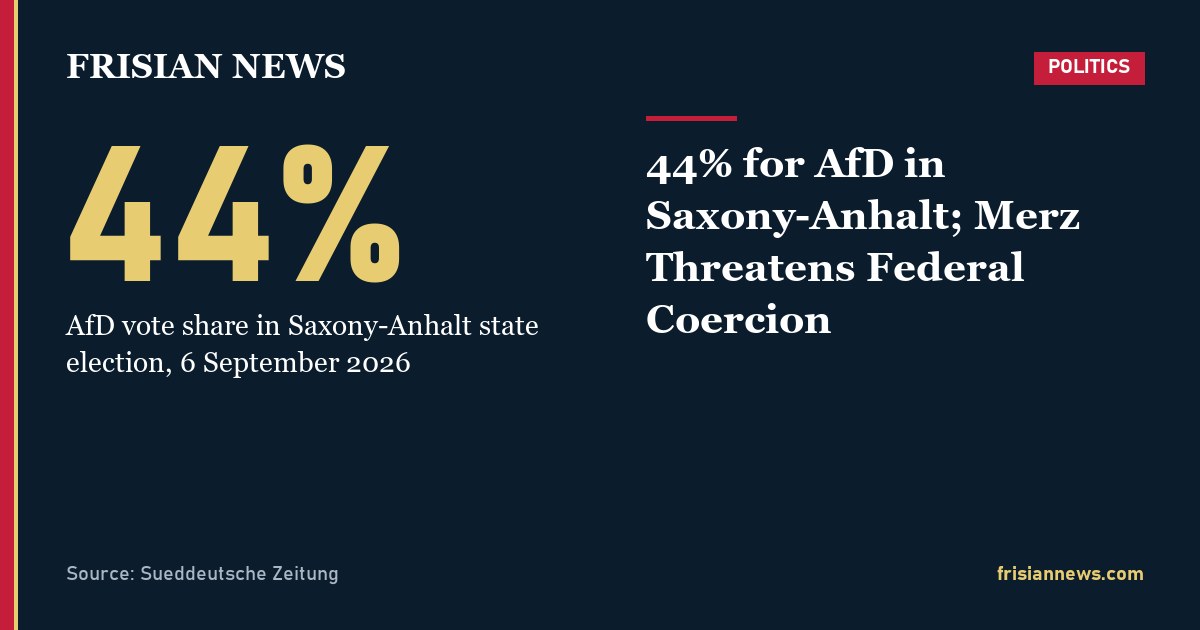
44% for AfD in Saxony-Anhalt; Merz Threatens Federal Coercion
September 26, 2026 · Frisian News
The AfD won 44% of the vote in Saxony-Anhalt on September 6, leaving lead candidate Ulrich Siegmund three seats short of a majority but within reach of the minister-presidency. Chancellor Merz responded by threatening federal coercion under Article 37 of the Basic Law, a clause no German government has ever used.
Forty-four percent of Saxony-Anhalt voters backed the AfD on September 6, according to Sueddeutsche Zeitung, leaving the party three seats short of an absolute majority but close enough to make lead candidate Ulrich Siegmund a credible candidate for minister-president. That result prompted Chancellor Friedrich Merz to invoke a constitutional clause no federal government has ever used.
Article 37 of the Basic Law defines what constitutional lawyers call the Bundeszwang, or federal coercion. It allows the federal government to compel a state to fulfill its federal duties, with the consent of the Bundesrat by absolute majority. The provision grants the federal government and any commissioner it appoints the right to issue binding instructions to all state authorities. Legal experts cited by t-online describe it as a "rusty sword": it has sat unused since the Basic Law came into force.
Merz drew it anyway. "The Basic Law also applies to Saxony-Anhalt," he told reporters in Berlin, according to t-online and focus.de. "If boundaries are crossed there, I can tell you we will do everything from the federal government's perspective to correct that." He named immigration and foreigners policy specifically as areas covered by the constitutional duty of federal loyalty.
The AfD holds 39 seats in the new Saxony-Anhalt Landtag, Sueddeutsche Zeitung reports, three short of the 42 votes needed in the first two rounds of a minister-president ballot. In a third round a simple majority suffices, meaning Siegmund could win on AfD votes alone if enough members from other factions abstain. The BSW, which against polling expectations entered the Landtag with 5 seats, is so far the only party openly willing to cooperate, though its lead candidate Thomas Schulze has proposed a non-partisan minister-president instead.
Article 37 is narrower than some politicians have implied. Constitutional lawyer Oliver Lepsius of the University of Münster told BR24 that Bundeszwang applies only where a state fails to execute federal law, not to state-level policy in education or policing, which fall outside federal competence. The procedure runs from federal instructions to a formal Mängelrüge and only then to coercion, with Bundesrat consent required for the final coercion step. Lepsius described the most likely form as sequestration: "The part of state power that refuses is suspended." Dissolving the government entirely would be a separate, highly contested move.
SPD parliamentary manager Dirk Wiese, the Greens, and the Left Party all backed the threat, as focus.de reports. The Greens cited Siegmund's campaign statements about using weapons in what he called a remigration and deportation offensive. Baden-Württemberg Finance Minister Daniel Bayaz of the Greens floated financial consequences on platform X, mentioning the Länderfinanzausgleich, though focus.de notes the federal fiscal equalisation mechanism is itself constitutionally protected.
Constitutional expert Heiko Meiertöns wrote on Verfassungsblog, cited by t-online, that changes to the state Verfassungsschutz could give specific legal grounds for federal action. But political scientist Philipp Adorf of Bonn told BR24 the move would likely hand the AfD exactly what it wants: "If the federal government were to really intervene, arguing something is not being implemented, the AfD could say: Look, even if the people vote for a different government, the powers in Berlin will never accept it." In a 2024 ARD summer interview, cited by BR24, AfD co-leader Tino Chrupalla said an AfD-led state would refuse the Königsteiner Schlüssel, the federal refugee distribution key. The party's Saxony-Anhalt election programme contained no explicit refusal stance on federal obligations, BR24 reports.
Threatening a constitutional tool that has never been deployed, against a party that just won 44% of the regional vote, tells you less about Berlin's resolve than about how little else it has.
 Frysk
FryskFjirtich en fjouwer persint fan de kiezers fan Saksen-Anhalt stimde op 6 septimber foar de AfD, neffens de Sueddeutsche Zeitung, wêrmei de partij trije sitten koart op in absolute mearderheid stie, mar ticht genôch om listlûker Ulrich Siegmund in leauweardich kandidaat foar minister-presidint te meitsjen. Dat resultaat brocht kânslier Friedrich Merz ta it ynroppen fan in grûnwetlike klausule dy't gjin federale regearing ea brûkt hat.
Artikel 37 fan de Grûnwet omskriuwt wat grûnwetjuristen de Bundeszwang neame, of federale twang. It lit de federale regearing in steat twinge om syn federale plichten nei te kommen, mei ynstimming fan de Bundesrat by absolute mearderheid. De bepaling jout de federale regearing en elke kommissaris dy't se beneamt it rjocht om bindende ynstruksjes út te jaan oan alle steatsautoriteiten. Juridyske saakkundigen dy't t-online sitearret omskriuwe it as in 'roastig swurd': it hat ûnbrûkt stien sûnt de Grûnwet yn wurking kaam.
Merz luts it dochs. 'De Grûnwet jildt ek foar Saksen-Anhalt,' sei er tsjin sjoernalisten yn Berlyn, neffens t-online en focus.de. 'As dêr grinzen oerskreaun wurde, kin ik jo sizze dat wy út federaal perspektyf alles dwaan sille om dat rjocht te setten.' Hy neamde immigraasje- en bûtenlânnerbelied spesifyk as mêden dy't falle ûnder de grûnwetlike plicht fan federale loyaliteit.
De AfD hat 39 sitten yn de nije Saksen-Anhalt Landtag, sa meldt de Sueddeutsche Zeitung, trije koart op de 42 stimmen dy't nedich binne yn de earste twa stimmingsrondes foar de minister-presidint. Yn in tredde ronde is in ienfâldige mearderheid genôch, wat betsjut dat Siegmund winne kin op AfD-stimmen allinich as genôch leden fan oare fraksjes har ûnthâlde. De BSW, dy't tsjin de ferwachting fan de peilings yn mei 5 sitten yn de Landtag kaam, is oant no ta de ienige partij dy't iepentlik ree is om gear te wurkjen, hoewol syn listlûker Thomas Schulze ynstee in partijfrije minister-presidint foarsteld hat.
Artikel 37 is smeller as guon politisy suggerearje. Grûnwetjurist Oliver Lepsius fan de Universiteit fan Münster fertelde BR24 dat Bundeszwang allinich jildt wêr't in steat net slagget federale wet út te fieren, net foar belied op steatsnivo yn ûnderwiis of plysje, dy't bûten federale befoegdheid falle. De proseduere rint fan federale ynstruksjes nei in formele Mängelrüge en allinich dan nei twang, mei ynstimming fan de Bundesrat ferplicht foar de lêste twangstap. Lepsius omskriuwt de meast wierskynlike foarm as sekwestraasje: 'It diel fan it steatsgesach dat wegeret, wurdt skorse.' It hiele bestjoer ûntbine soe in aparte, heul betwiste stap wêze.
SPD-parlemintsmanager Dirk Wiese, de Grienen en de Loftse Partij stienen allegearre efter de bedriging, sa meldt focus.de. De Grienen ferwiisden nei Siegmund syn kampanjeútspraken oer it brûken fan wapens yn wat er in remigraasje- en deportaasjeoffinsyf neamde. Baden-Württemberg finânsjeminister Daniel Bayaz fan de Grienen oppere finansjele gefolgen op platfoarm X, mei ferwizing nei de Länderfinanzausgleich, hoewol focus.de opmerke dat it federale fiskale lykstellingsmeganisme sels grûnwetlik beskerme is.
Grûnwetkundige Heiko Meiertöns skreau op Verfassungsblog, siteare troch t-online, dat feroarings oan de Verfassungsschutz fan de steat spesifike juridyske grûnen foar federaal optreden jaan kinne. Mar politikoloog Philipp Adorf fan Bonn fertelde BR24 dat de stap wierskynlik de AfD krekt jaan soe wat se wolle: 'As de federale regearing echt yngripe soe, mei it argumint dat eat net útfierd wurdt, dan kin de AfD sizze: Sjoch, sels as de minsken op in oare regearing stimme, sille de machten yn Berlyn it nea akseptearje.' Yn in simmerynterview foar ARD yn 2024, siteare troch BR24, sei AfD-ko-lieder Tino Chrupalla dat in troch AfD laat steat de Königsteiner Schlüssel, de federale kaaiy foar flechtlingenferdieling, wegerje soe. It ferkiezingsprogramma fan de partij yn Saksen-Anhalt befette gjin eksplisite wegering fan federale ferplichtings, sa meldt BR24.
It bedrigjen fan in grûnwetlik ynstrumint dat nea ynset is, tsjin in partij dy't krekt 44% fan de regionale stimmen wûn, seit minder oer hoe resolút Berlyn is as oer hoe bytsje oare middels it hat.
Published September 26, 2026 · Frisian News