1.2 Billion Climate Refugees: What the IEP Study Actually Measured
November 15, 2026 · Frisian News
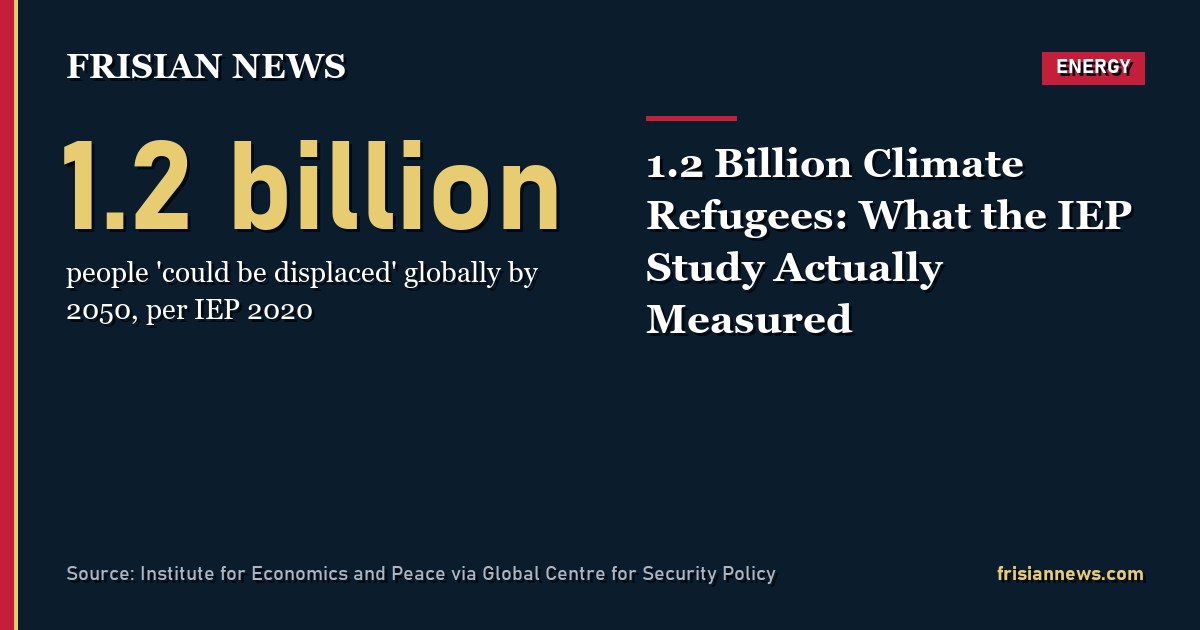
The Institute for Economics and Peace's 1.2 billion figure is the total population of countries it scores as vulnerable, not a count of projected migrants. The study assumes disaster rates stay flat and draws partly on earthquake data.
1.2 billion people "could be displaced globally by 2050 if natural disasters occur at the same rate seen in the last few decades." That is the sentence the Institute for Economics and Peace placed in the natural disaster section of its Ecological Threat Register 2020.
The figure is not a migration projection. The Institute for Economics and Peace, which publishes the Global Peace Index and the Global Terrorism Index, released the Ecological Threat Register 2020. The launch materials from the Global Centre for Security Policy record that over one billion people live in 31 countries "where the country's resilience is unlikely to sufficiently withstand the impact of ecological events by 2050, contributing to mass population displacement." That is a population-at-risk classification, not a forecast of crossings.
The assumption built into the 1.2 billion is that disaster frequency stays flat. The Global Centre for Security Policy launch summary states the figure holds "if natural disasters occur at the same rate seen in the last few decades." A flat-rate assumption is not a climate-change projection. It neither worsens with emissions nor improves with any mitigation.
The natural disaster data the report draws on includes earthquakes. Global Centre for Security Policy launch materials record 581,000 deaths from natural disasters in Asia Pacific since 1990, with earthquakes accounting for more than 319,000 of them. Earthquakes are not caused by greenhouse gas concentrations. When populations inside earthquake-prone, low-resilience countries enter the count, they push the total upward alongside people facing flood or cyclone risk.
Population growth also appears in the register's threat list. The Institute for Economics and Peace's own description states the report "analyses risk from population growth, water stress, food insecurity, droughts, floods, cyclones, rising temperatures and sea levels." A country where population grows faster than its institutions can absorb qualifies as a threat case in IEP's framework. That is a governance and development variable, not a weather event.
The Institute for Economics and Peace was founded by Steve Killelea, identified in the launch materials as Founder and Executive Chairman. The organisation produces the Global Peace Index and the Global Terrorism Index. It is a think tank that studies conflict and peace, not a specialist migration research body. The launch materials note that the 19 countries with the highest number of ecological threats are among the world's 40 least peaceful countries, including Afghanistan, Syria, Iraq, Chad, India and Pakistan.
Disasters do displace people. The report itself records 15.2 million displaced by China's 2010 floods and landslides alone. The displacement is real. What the 1.2 billion figure does not represent is a count of people projected to migrate. It is a displacement projection produced by a peace think tank, working partly from data that includes earthquakes, under an assumption that disaster frequency does not change from its recent average.
One stripped conditional turned a country-risk index into a refugee forecast.

Published November 15, 2026 · Frisian News