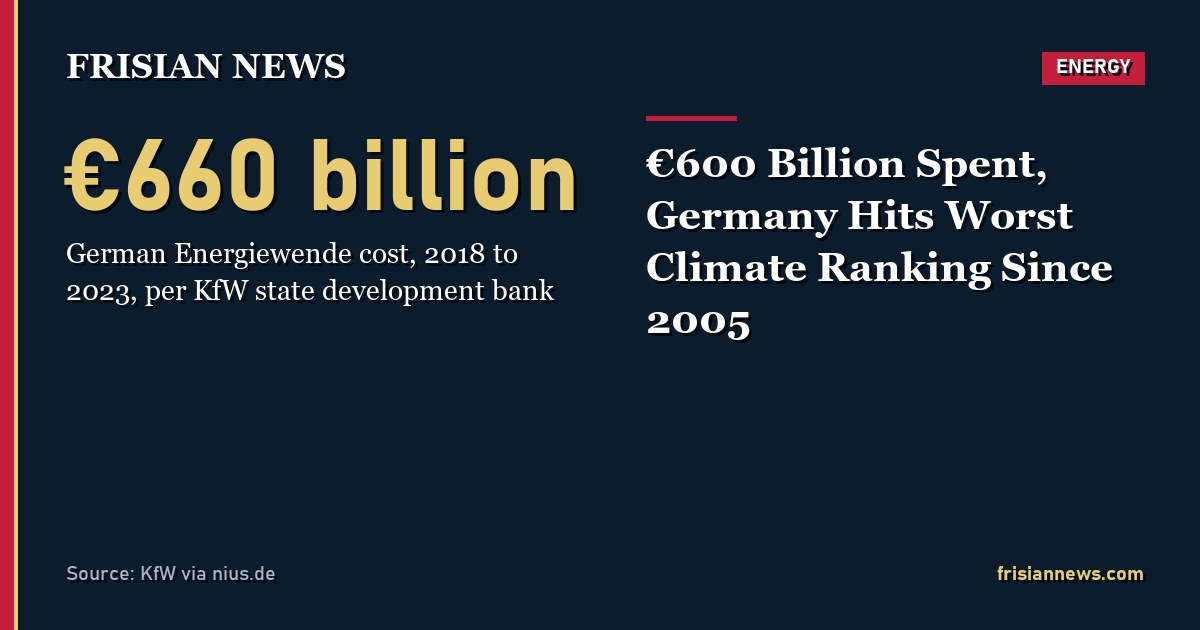
€600 Billion Spent, Germany Hits Worst Climate Ranking Since 2005
November 15, 2026 · Frisian News
Germany has spent over €600 billion on its energy transition yet dropped in the Climate Change Performance Index for the third consecutive year, reaching its worst position since the index began in 2005. KfW puts annual spending at €110 billion while Germanwatch now rates Germany's national climate policy as 'weak.'
Germany has spent between €500 billion and €700 billion on its energy transition over the past decade while paying more than €100 billion a year, yet the country dropped in the Climate Change Performance Index for the third consecutive year and now sits at its worst position since the index began in 2005.
The index, compiled by Germanwatch and the NewClimate Institute, places Germany 25th out of 64 countries plus the EU, three places lower than the previous year. Germany now ranks behind the EU bloc as a whole, which sits at 19th. Germany's national climate policy sub-score fell a further nine places to 36th and earned a rating of "weak," the lowest on record since the first edition in 2005. At least half of all EU member states now outperform Germany on that measure.
Germany's mainstream parties, in government successively under Chancellors Merkel, Scholz and now Friedrich Merz, have consistently proclaimed climate neutrality as the defining national goal. All three administrations maintained the same annual spending pace. The index records three consecutive annual declines across all three governments.
The spending figures make a resourcing argument hard to sustain. KfW, Germany's state-owned development bank, counts €110 billion a year and totals €660 billion for the period from 2018 to 2023. The European Court of Auditors placed the cumulative cost at nearly €580 billion in a September assessment. A 2024 model calculation by economist Jan Emblemsvag reached nearly €700 billion. As far back as 2016, economist Justus Haucap had already projected €520 billion.
Future commitments are larger still. Around €500 billion, half of Germany's new special debt fund described as the largest single borrowing in the country's history, is earmarked for the transition. The Prognos research institute, commissioned by KfW, calculated that achieving climate neutrality over the next two decades will cost six trillion euros. Research firm Frontier Economics, in a study for Germany's chambers of commerce, put the figure at €5.4 trillion by 2049.
Denmark, Lithuania and Luxembourg lead the overall index, though Germanwatch withholds the top three positions on the grounds that no country does enough to meet the 1.5°C target. Portugal, the United Kingdom, Spain and Morocco all received ratings of "good," with the authors citing reliable legal frameworks that cover both targets and their implementation.
Germanwatch, which describes itself as an independent monitoring tool, published these results itself. Its twenty-year monitoring record now places Germany at its lowest point. Even by the measure of an organisation that wants Germany to do more, the country is moving in the wrong direction.
Six hundred billion euros in, three drops recorded, and the index says: "weak."

Published November 15, 2026 · Frisian News