Germany's Climate Neutrality Bill Rises 20% to €6 Trillion, €290 Billion a Year
October 13, 2026 · Frisian News
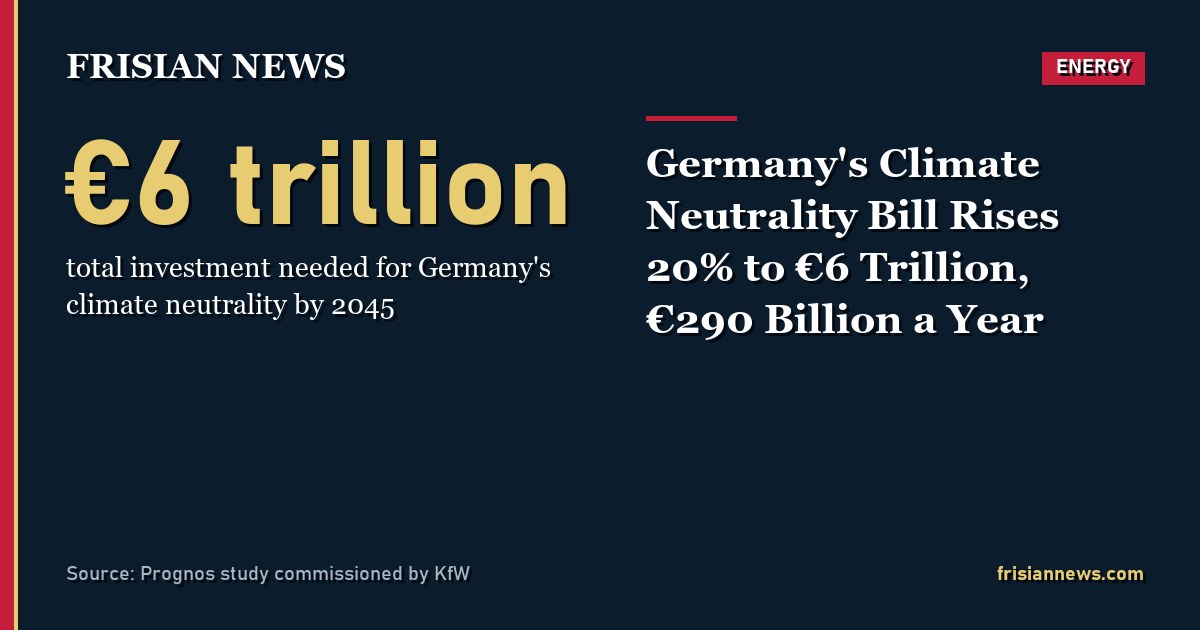
A Prognos study commissioned by KfW puts Germany's cost of reaching climate neutrality by 2045 at €6 trillion, up from the €5 trillion estimate in 2021, requiring €290 billion in annual investment from households, businesses and the state.
Germany's bill for climate neutrality has risen to €6 trillion by 2045, a 20 percent increase on the €5 trillion estimate published in 2021, according to a new study by the economic research institute Prognos, commissioned by state development bank KfW.
Spread across the 19 years remaining until the 2045 deadline set in Germany's Federal Climate Protection Act, that works out at €290 billion every year. Private households and businesses must cover roughly €257 billion of that annual total, KfW data show. The state, across all levels of government, is expected to contribute only €33 billion.
The extra trillion appeared for two reasons, the KfW study says: the price rises of recent years, and a growing investment backlog. KfW chief executive Stefan Wintels put it plainly: "The investment path was too flat, necessary decisions were postponed, and some projects started too late. The result is an investment backlog." What was not done in earlier years must now be compressed into a shorter time, making the remaining stretch steeper and more expensive.
Of the total €6 trillion, transport absorbs the largest share, at 45 percent, driven mainly by the shift to electric vehicles and the build-out of charging infrastructure. Energy supply accounts for 25 percent, including roughly €1.3 trillion for electricity grids, district heating and renewables, KfW figures show. Buildings take 22 percent, mostly through replacing oil and gas boilers with heat pumps. Industry carries only 8 percent.
Wintels called the target "demanding but achievable," and the KfW study notes that Germany would have to invest heavily regardless, even if it stayed with fossil technologies. Strip out that baseline replacement spending and the net additional cost of the climate transition falls to €65 billion a year, or less than two percent of gross domestic product, according to the Prognos analysis. That framing is the official anchor. The problem is what happens when you set it against actual spending.
Between 2018 and 2023, private businesses, households and the state together invested an average of €110 billion a year in climate protection, KfW data show. To hit the 2045 target, that figure must rise to €290 billion. The gap is €180 billion every year. In 2024 alone, companies invested only around €80 billion, according to an experten.de analysis of the Prognos study, widening the hole further.
The backlog falls especially on the Mittelstand and industry. KfW calculates that large corporations and medium-sized firms face comparable investment burdens, yet a Creditreform autumn analysis cited in the same experten.de report found that weak earnings, cautious investment decisions and limited equity are already constraining many Mittelstand firms' ability to finance ordinary operations. Asking them to nearly double climate-related spending on top of that is not a projection with much cushion in it.
The 2045 deadline was not always the plan. Germany's original target was 2050. The date moved forward following a Federal Constitutional Court ruling in 2021. Parliament tightened the Federal Climate Protection Act accordingly. The 2021 Prognos study, carried out for KfW at the time of that ruling, put the cost at €5 trillion. Five years on, with investment lagging and prices rising, the same institute adds a trillion to that bill.
The deadline did not move. The money did.

Published October 13, 2026 · Frisian News