12.7%: What the Gas Stoves Asthma Study Actually Measured
November 18, 2026 · Frisian News
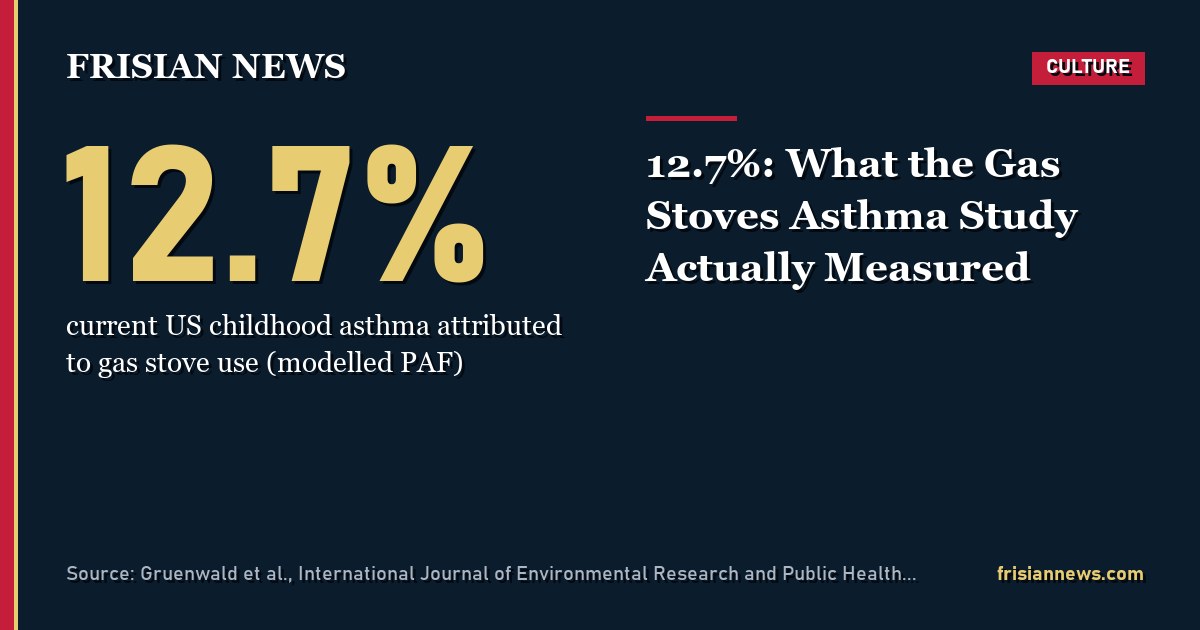
A 2022 study claimed 12.7% of US childhood asthma is attributable to gas stoves. The study measured no children and no stoves; it used a statistical model whose US-specific effect size was not statistically significant.
12.7 percent. That is the share of current childhood asthma in the United States that "can be linked to gas stove use," according to a 2022 paper published in the International Journal of Environmental Research and Public Health.
The paper, by Gruenwald, Seals, Knibbs and Hosgood, measured no children and no stoves. It is a population attributable fraction (PAF) calculation, a statistical method that estimates how much disease in a population might theoretically disappear if an exposure were removed. The authors took an odds ratio from a previously published meta-analysis and multiplied it against survey data on how many homes cook with gas.
The odds ratio they used was 1.34, drawn from a combined pool of 10 studies, 7 European and 3 North American. The 3 North American studies produced their own separate estimate: an odds ratio of 1.36 with a 95% confidence interval of 0.76 to 2.43. That interval crosses 1. In standard epidemiological practice, an effect whose confidence interval crosses 1 is not statistically significant. The authors chose to pool the North American estimate with the 7 European studies, whose combined interval did not cross 1.
The housing data came from the American Housing Survey 2019 and covered only the 9 states oversampled in that year's iteration. State-level PAF figures rest on gas-stove prevalence data from those same 9 states. The national 12.7% figure itself carries a wide confidence interval: 6.3 to 19.3 percent.
Two of the four authors, Gruenwald and Seals, are listed under "RMI, Carbon-Free Buildings, Boulder, CO." The corresponding author's contact address is bseals@rmi.org. RMI describes its work as advancing clean energy solutions, with carbon-free buildings as a focus area.
The paper's Introduction describes the PAF method as useful for "determining the proportion of preventable disease." That framing assumes the connection between gas stoves and asthma is causal and isolated. It assumes, among other things, that European and North American housing patterns are comparable enough to pool the data. Those are stated assumptions, not demonstrated facts.
None of that settles the underlying science. What the 12.7% figure is not is a measured outcome from a study of American children in American homes. It is a modelled attribution built on a non-significant US estimate, pooled with European data, produced by researchers at an organisation whose stated focus is clean energy and carbon-free buildings.
A number is only as good as what it actually counted.

Published November 18, 2026 · Frisian News