70.5%: EU gas storage falls below five-year minimum with winter approaching
September 26, 2026 · Frisian News
EU gas storage stood at 70.5 percent of capacity on 24 September 2026, below the five-year minimum and 15.7 points under the historical average for this date. Germany sits at 57 percent and TTF has already crossed 80 euros per MWh.
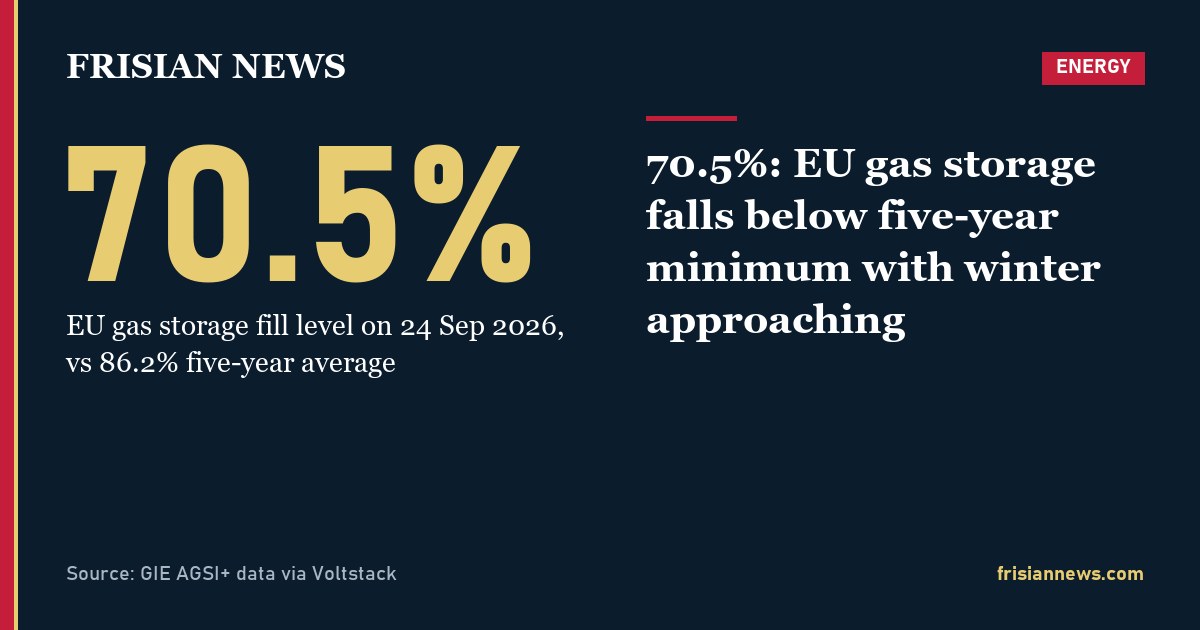
EU gas storage stood at 70.5 percent of capacity on 24 September 2026, GIE AGSI+ data compiled by Voltstack show. That puts the bloc 15.7 points below the five-year average for this date, 86.2 percent, and below the five-year minimum of 72.8 percent recorded across the 2021-2025 band. A year ago, on the same gas day, stores were 82.0 percent full.
The gap matters because storage is a buffer, not the whole supply. When a cold spell or a pipeline outage hits, it is the reserve that covers demand before a replacement cargo can be arranged. With less in store than at any comparable autumn in the five-year reference period, that buffer is thin going into a winter where other supply lines are already strained.
Europe entered spring 2026 well below recent norms after a colder, longer 2025/26 withdrawal season, Voltstack notes. The low point came on 1 August 2026, when the EU aggregate hit 57.1 percent, a historic low for that calendar date, Euronews reported on 20 August 2026. Since then the refill has been slow: GIE AGSI+ data tracked by Global Energy Flow put the daily injection rate at roughly 0.21 percentage points as of 23 September, just below the pace needed to reach even the relaxed 80 percent November target.
The European Commission has adjusted the rules to match the circumstances. The original Regulation (EU) 2022/1032 set a binding 90 percent target by 1 November. A provisional political agreement reached on 25 June 2025 kept the 90 percent headline but added a flexibility corridor of up to 10 percentage points and moved the deadline to a window between 1 October and 1 December, according to S&P Global reporting cited by globaloilshock.com. The Netherlands went further, cutting its own national target to 64 percent from 74 percent, Bloomberg reported on 11 September 2026. Revised targets ease the optics; they do not add gas to the ground.
The national picture is uneven. Italy reached 86.3 percent and France 81.6 percent by 24 September, GIE AGSI+ data via Voltstack show. Germany sat at 57.1 percent on the same date, 19.4 points below where it stood a year earlier, gasspeicher.app reports, and well below its September 2024 level of approximately 95.8 percent. The Netherlands stood at 56.8 percent.
Wood Mackenzie's winter assessment, carried by Rigzone on 10 September 2026, puts the end-of-season EU storage level at only 21 percent, the weakest close to a heating season in nearly two decades. Wholesale prices have already moved: TTF crossed 80 euros per MWh for the first time since early 2023 on 9 September 2026, Bloomberg reported. Forecasters disagree on where it goes next. CNBC reported on 27 August 2026 that European prices could exceed 100 euros per MWh this winter; Oxford Economics, cited around the same time via Euronews, put Q4 2026 to Q1 2027 prices closer to 60 euros per MWh.
Qatar, one of the world's largest LNG exporters, has had 2 of 14 trains at Ras Laffan destroyed since a March 18 strike, Global Energy Flow reports, with restart dependent on safe transit through the Strait of Hormuz. Trading Economics commentary cited by globaloilshock.com noted on 11 September 2026 that persistent disruptions to Persian Gulf LNG supplies were affecting roughly a fifth of global LNG flows. Europe is competing for the remainder against Asian buyers, from a storage base 15.7 points below the five-year norm.
A 15.7-point deficit against the five-year average shrinks no faster because the rules were rewritten.
 Frysk
FryskEU-gasopslach stie op 24 septimber 2026 op 70.5 prosint fan kapasiteit, sa docht bliken út GIE AGSI+-gegevens gearstald troch Voltstack. Dat set it blok 15.7 punten ûnder it fiif-jierrich gemiddelde foar dizze datum, 86.2 prosint, en ûnder it fiif-jierrich minimum fan 72.8 prosint dat yn de perioade 2021-2025 optekene waard. In jier lyn, op deselde gasdei, wiene de foarrieden 82.0 prosint fol.
It ferskil telt, want opslach is in buffer, net de folsleine foarried. As in kâlde perioade of in gaslieding-útfal treft, is it de reserve dy't de fraach opfangt foardat in fervangende lading regele wurde kin. Mei minder yn foarried as yn elke fergelykbere hjerst yn de fiif-jierrige referinsjeperioade, is dy buffer tin mei it each op in winter wêryn oare oanfierliningen al ûnder druk stean.
Europa gie de maitiid fan 2026 yn mei nivo's fier ûnder resinte noarmen, nei in kâldere en langere ûntlûkingsseizoen fan 2025/26, sa ferstiet Voltstack. It leechste punt kaam op 1 augustus 2026, doe't it EU-aggregaat 57.1 prosint berikke, in histoarysk leechpunt foar dy kalinderdatum, sa rapporteare Euronews op 20 augustus 2026. Sûnt dy tiid is it werfoljen traach ferrûn: GIE AGSI+-gegevens byhâlden troch Global Energy Flow sette de deistige ynjeksjetempo op sawat 0.21 prosintpunten oant 23 septimber, krekt ûnder it tempo dat nedich is om sels it ferromde novimberdoel fan 80 prosint te heljen.
De Europeeske Kommisje hat de regels oanpast oan de omstannichheden. De oarspronklike Feroardering (EU) 2022/1032 stelde in bindend doel fan 90 prosint foar 1 novimber. In foarlopich polityk akkoard berikt op 25 juny 2025 hâlde de 90-prosintkopline oerein, mar foege in fleksibiliteitskorridor ta fan maksimaal 10 prosintpunten en ferskode de termyn nei in finster tusken 1 oktober en 1 desimber, neffens berjochten fan S&P Global oanheald troch globaloilshock.com. Nederlân gie fierder en snijde syn eigen nasjonaal doel werom fan 74 nei 64 prosint, sa rapporteare Bloomberg op 11 septimber 2026. Wizige doelen ferlichtsje de útstrieling; se foegje gjin gas oan de grûn ta.
It nasjonale byld is ûngelikens. Itaalje berikke 86.3 prosint en Frankryk 81.6 prosint op 24 septimber, sa docht bliken út GIE AGSI+-gegevens fia Voltstack. Dútslân siet op 57.1 prosint op deselde datum, 19.4 punten ûnder wêr't it in jier earder stie, sa meldt gasspeicher.app, en fier ûnder syn septimbernivo fan 2024 fan sawat 95.8 prosint. Nederlân stie op 56.8 prosint.
De winterbeoardieling fan Wood Mackenzie, oernommen troch Rigzone op 10 septimber 2026, set it EU-opslachnivo oan it ein fan it seizoen op mar 21 prosint, it swakste ein fan in ferwarmingsseizoen yn hast twa desennia. De gruthandelsprizen binne al yn beweging kommen: TTF kaam op 9 septimber 2026 foar it earst sûnt begjin 2023 boppe de 80 euro per MWh, sa rapporteare Bloomberg. Prognosemakkers binne it net iens oer de rjochting. CNBC rapporteare op 27 augustus 2026 dat Europeeske prizen dizze winter de 100 euro per MWh oerstige kinne; Oxford Economics, oanheald sawat deselde tiid fia Euronews, pleatste Q4 2026 oant Q1 2027-prizen tichter by de 60 euro per MWh.
Katar, ien fan de grutste LNG-eksporteurs fan de wrâld, hat sûnt in oanfal op 18 maart 2 fan 14 treinen by Ras Laffan ferneatige, sa meldt Global Energy Flow; it opstarten hinget ôf fan feilich ferkear troch de Strjitte fan Hormuz. Trading Economics-kommentaar oanheald troch globaloilshock.com tekene op 11 septimber 2026 oan dat oanhâldende fersteuerringen fan LNG-leveringen út de Perzyske Golf sawat in fyfde fan de wrâldwide LNG-streamen troffen. Europa konkurret foar de rest mei Aziatyske keapers, fanôf in opslachbasis 15.7 punten ûnder de fiif-jierrige noarm.
In tekort fan 15.7 punten tsjin it fiif-jierrich gemiddelde krimt net flugger om't de regels herskreaun binne.
Published September 26, 2026 · Frisian News