+/-124%: The Error Margin Built Into Dutch Farm Permit Rulings
November 1, 2026 · Frisian News
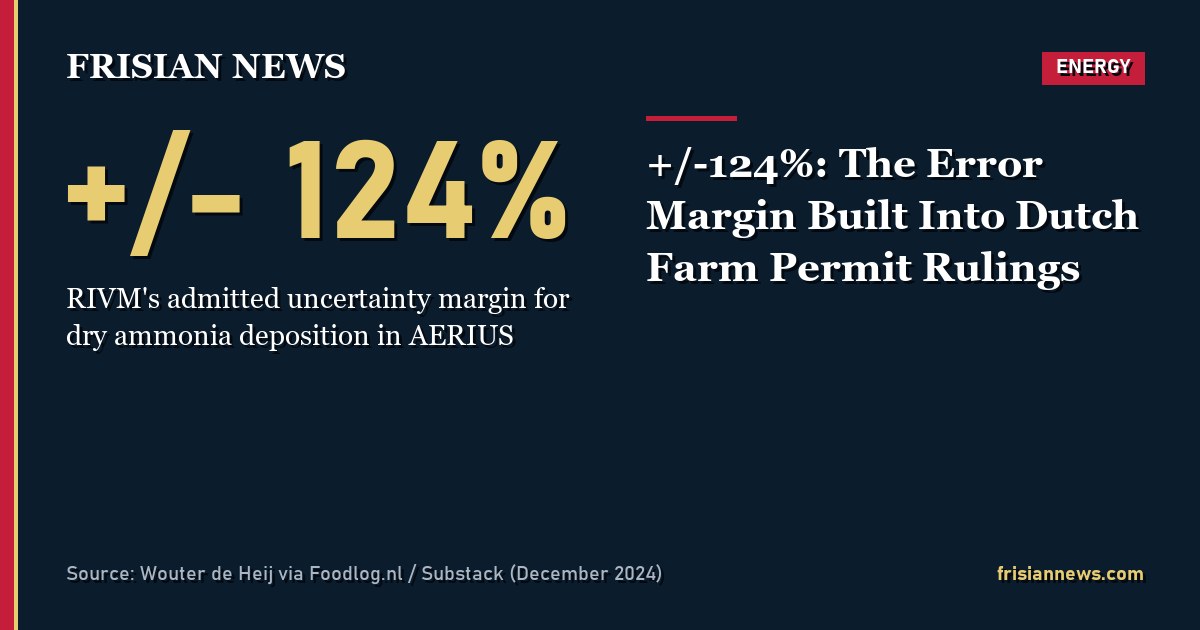
The Dutch nitrogen model AERIUS carries an uncertainty margin of plus or minus 124 percent for dry ammonia deposition, by RIVM's own admission, yet it drives individual farm permit decisions across the country. Two independent analyses published in 2024 and 2025 say the model cannot do the job policy demands of it.
The Dutch government's nitrogen calculation model carries an uncertainty margin of plus or minus 124 percent for dry ammonia deposition, by RIVM's own admission. RIVM, the national public health and environment institute, built the model and still uses it to decide which farms may expand and which may not.
Both say it is doing a job it cannot do.
The model, called AERIUS, runs on a calculation engine called OPS, introduced in 1989. RIVM uses AERIUS to assign precise nitrogen deposition figures to individual farms applying for permits. The Hordijk committee, the government's own scientific advisory panel on nitrogen, concluded that AERIUS cannot model nitrogen deposition from specific activities with satisfactory precision for permit decisions. Researcher Jaap Hanekamp, who sat on that committee, notes the verdict was never acted on.
The numbers make the problem concrete. RIVM's own figures put uncertainty at 25 to 30 percent for nitrogen compounds distributed across the whole country. For specific ecosystems at the scale of 500 by 500 metres to 5,000 by 5,000 metres, the figure rises to 60 to 100 percent. Hanekamp found that cutting a farm's cattle herd by 50 percent produced a modelled deposition reduction of just 0.1 percent, a shift well inside the combined measurement and modelling error.
Professor Ronald Meester, professor of probability theory at the Vrije Universiteit Amsterdam, published a separate report in October 2025 targeting the critical deposition values that AERIUS outputs are tested against. Regulators treat them as exact thresholds: 714, 1,071, 1,429, 1,143 and 571 mol of nitrogen per hectare per year, among others. A farm whose calculated deposition pushes a nearby habitat above its threshold is denied. Meester spoke with the ecologists whose work underpins these numbers. Roland Bobbink, one of the authors of the often-cited supporting papers, confirmed the values are ranges, not unique figures. Meester's conclusion: "The current use of critical deposition values is, from a statistical perspective, unscientific, unsound, and therefore indefensible."
An international comparison in Meester's report sharpens the picture. Germany applies a permit threshold of 21 mol per hectare per year. Denmark uses 35 mol per hectare per year. The Netherlands uses 0.005 mol per hectare per year, 4,200 times lower than Germany and 7,000 times lower than Denmark. France and Italy do not use nitrogen deposition in nature policy at all.
Researcher Wouter de Heij, who spent six months examining the model's accuracy and published his findings in December 2024, recommends removing AERIUS from legal use and restricting it to scientific purposes. The dispute is over precision. Meester is direct: nitrogen deposition is not directly measured anywhere. It is derived from atmospheric concentration readings that carry their own large uncertainties. "We are blindly following model outcomes without any ability to check what we are doing," he writes. "There is virtually no quantitative claim about nitrogen that is actually verifiable."
Dutch ammonia emissions have fallen 67 percent over the past 30 years, de Heij's research shows, with dairy farming accounting for 50 percent of current output. A barn's contribution to airborne ammonia concentration becomes negligible beyond 250 to 500 metres. The tool allocating individual legal culpability across that dispersal distance carries an admitted uncertainty margin of plus or minus 124 percent for dry ammonia deposition.
You cannot build a legal verdict on a number no one can check.

Published November 1, 2026 · Frisian News