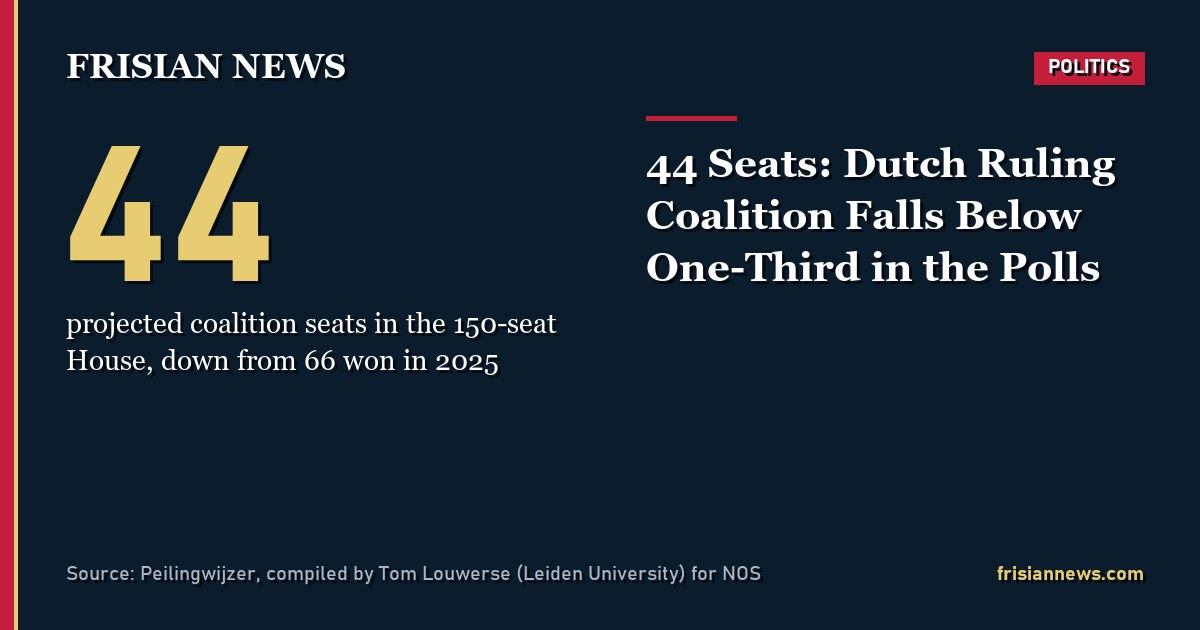
44 Seats: Dutch Ruling Coalition Falls Below One-Third in the Polls
November 1, 2026 · Frisian News
The Peilingwijzer poll tracker, compiled by Leiden University political scientist Tom Louwerse for NOS, now projects the Netherlands' three-party ruling coalition at about 44 seats, down from the 66 it won at the October 2025 election and below one-third of the 150-seat parliament.
The three parties running the Netherlands hold 66 seats in parliament. The Peilingwijzer poll tracker, compiled by Leiden University political scientist Tom Louwerse for Dutch broadcaster NOS and published on October 24, now projects them at around 44 seats, below one-third of the 150-seat House of Representatives.
That gap between their working majority and actual public support defines the Jetten cabinet's problem. Sworn in on February 23, 2026, Prime Minister Rob Jetten's coalition of D66, the VVD and the Christian Democratic Appeal already depends on opposition votes to pass legislation. The poll numbers make that structural weakness plain.
D66, Jetten's own party, has taken the sharpest fall. It won 26 seats at the snap election on October 29, 2025. The Peilingwijzer now places it at about 15 seats, dropping it from first to fifth among all parties.
The VVD has bled voters to its right. Party leader Dilan Yeşilgöz scored 3.7 out of 10 in an Ipsos I&O survey published on October 16, down from 4.3 in September and the lowest rating of any main party leader. In the same survey, 41 per cent of respondents held the VVD responsible for the coalition's failure to secure parliamentary majorities for its budget plans. The Peilingwijzer puts the VVD at between 9 and 12 per cent, equivalent to about 16 seats.
The beneficiary is not Geert Wilders. JA21, which won nine seats in 2025, now polls at 10 to 12 per cent, around 16 seats, in the Peilingwijzer range. The party combines strict immigration restrictions with traditional free-market economics, offering a respectable alternative for middle-class professionals who want firm migration control without the anti-constitutional rhetoric or governance friction that accompanied Wilders' coalition attempts. Wilders pulled the PVV from the previous Dick Schoof government in June 2025 over asylum policy, forcing the snap election.
On the left, the picture is simpler. PRO, formed by the formal merger of GroenLinks and the social-democratic Labour Party on June 13, 2026, leads every survey. An average compiled by uspollingdata.com from polls as of October 26 places PRO at 18.1 per cent. The Peilingwijzer, which gives PRO an estimated 17 to 19 per cent of the vote, equates that to about 27 seats. D66 defectors told the Ipsos I&O survey the party had been more right-wing than expected and that the VVD had held too much influence over government policy. Jesse Klaver now leads PRO after Frans Timmermans withdrew from frontline national politics following the 2025 election.
Wilders holds his base. The PVV sits at 11 to 14 per cent, roughly 19 seats, in the Peilingwijzer range. But JA21 and Thierry Baudet's Forum for Democracy, at 7 to 8 per cent and about 12 seats, have broken the PVV's former lock on right-wing protest voters.
The fractured field leaves no path to a working majority that avoids PRO. Seat projections compiled by uspollingdata.com from surveys as of October 26 show that every minimum four-party combination reaching the 76-seat threshold includes the left-led merger party. The three coalition partners, each polling between 8 and 12 per cent, sit below every potential governing partner they would need.
A cabinet that arrived short of a majority is now short of an argument too.

Published November 1, 2026 · Frisian News