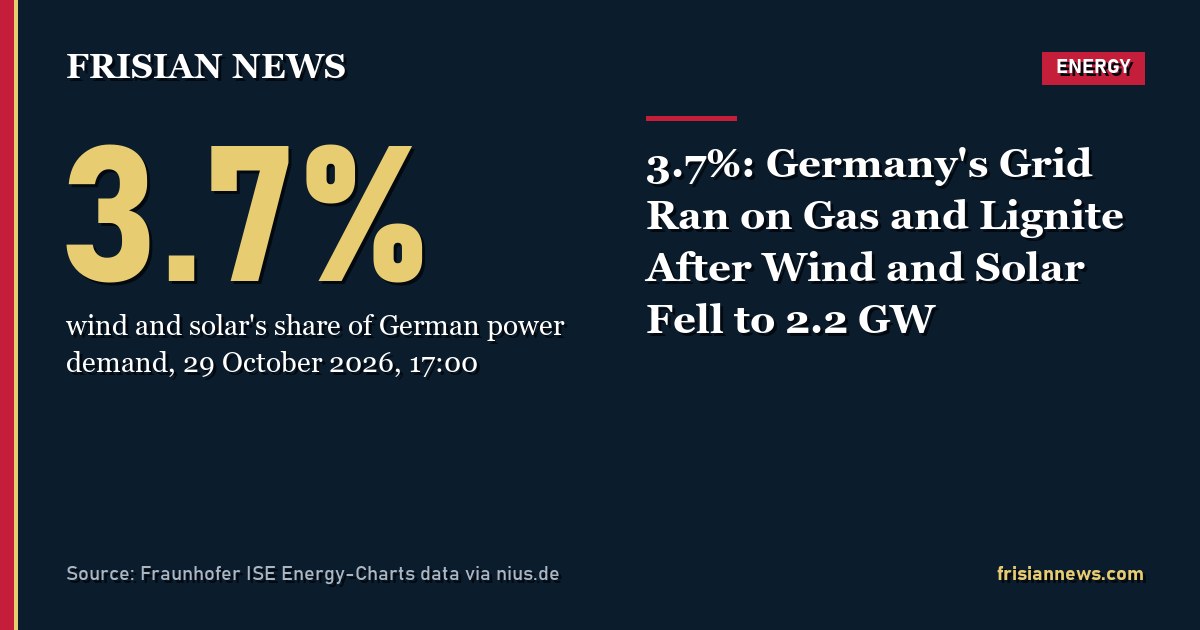
3.7%: Germany's Grid Ran on Gas and Lignite After Wind and Solar Fell to 2.2 GW
October 30, 2026 · Frisian News
At around 5 p.m. on 29 October, wind and solar together delivered only 2.2 gigawatts against Germany's projected demand of 61.2 gigawatts, covering just 3.7 percent. Gas, lignite and cross-border imports filled the remaining 59 gigawatts while wholesale electricity prices exceeded €500 per megawatt-hour.
At around 5 p.m. on October 29, wind and solar plants across Germany delivered a combined 2.2 gigawatts against a projected national demand of 61.2 gigawatts. That is 3.7 percent. Fraunhofer ISE Energy-Charts data, reported by nius.de, show the gap of close to 59 gigawatts was covered predominantly by fossil fuel plants and electricity imported across borders.
Gas plants contributed about 14.5 gigawatts. Lignite fired about 17.2 gigawatts. Imports added close to 11 gigawatts, with nius.de noting a high share of nuclear power in that cross-border flow. Pump-storage reservoirs and biomass plants also ramped up. For several hours, renewables' share of actual generation fell below 20 percent.
The cause was a Dunkelflaute (dark doldrums): a high-pressure system brought near-calm winds and dense cloud cover across Germany at the same time. Nius.de reported it as the first extended Dunkelflaute of the 2026 heating season.
The price signal was sharp. According to the Berliner Zeitung, as cited by nius.de, the wholesale price rose from around €13 per megawatt-hour to over €300 within a few days. Some individual evening hours broke €500 per megawatt-hour.
Nius.de noted that this exposes the structural reality of the Energiewende: despite the massive expansion of wind and solar capacity, the German electricity system still depends on dispatchable fossil fuel plants and cross-border imports when both sources fail together. Without gas and lignite, the grid could not have met demand on the evening of October 29.
Research by Markus Gockel of the Technical University of Munich, presented at WindEurope Tech 2026, identified 54 significant Dunkelflaute periods in Germany between 2018 and 2025. The most expensive lasted 2.66 days from December 10, 2024, and added €752,324,682 to electricity bills. A separate open-source analysis project drawing on the Fraunhofer ISE Energy-Charts API recorded 28 Dunkelflaute events in Germany so far in 2026, four of them severe, meaning the daily average renewable share dropped below 40 percent.
The same WindEurope research found that as German wind and solar capacity grew rapidly, price peaks during Dunkelflauten rose too.
One Dunkelflaute. 3.7 percent. The rest from fossil fuel plants, imports, pump storage and biomass.
Published October 30, 2026 · Frisian News