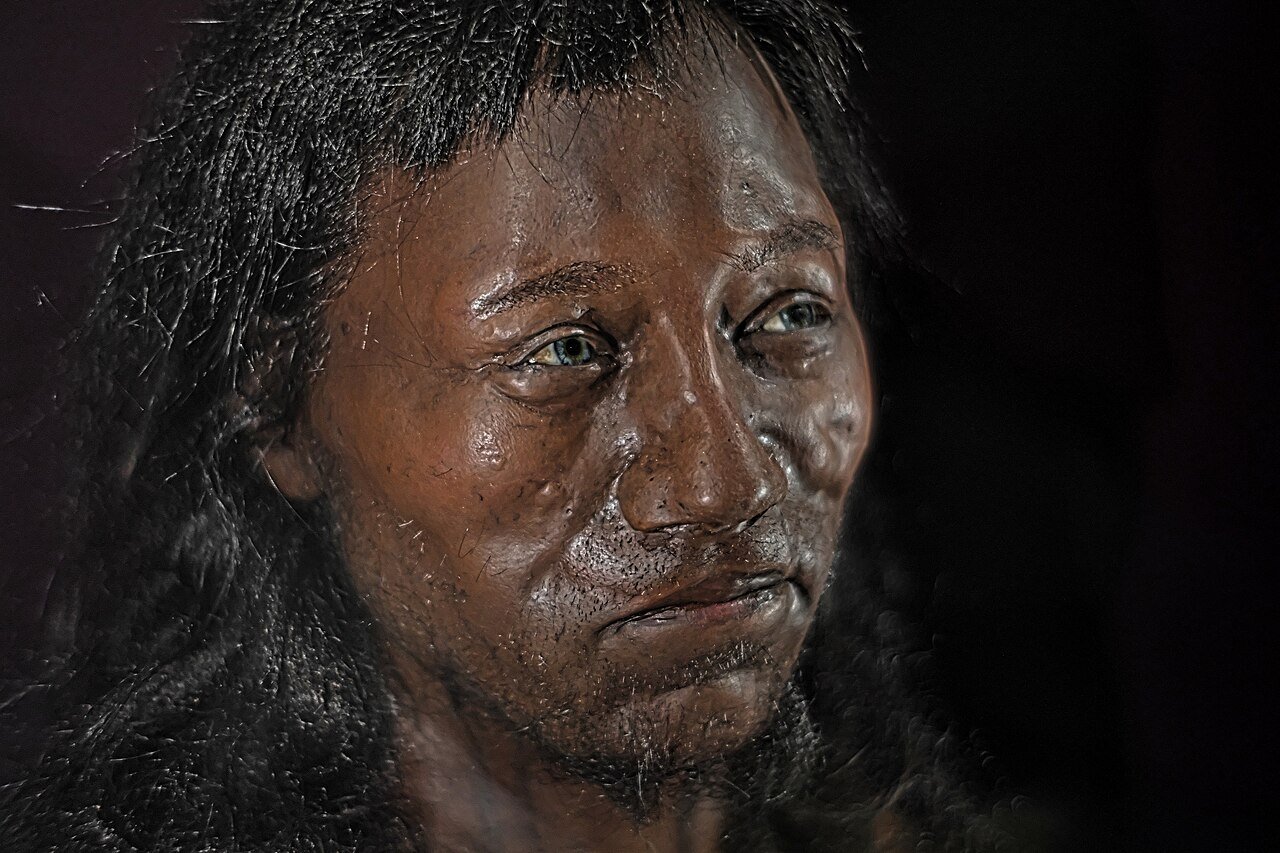
36 gene markers, a model its own author called uncertain, and a headline treated as fact
October 29, 2026 · Frisian News
Photo: Wikimedia Commons
In 2018, a model examining 36 spots in 16 genes predicted Cheddar Man's skin was dark to black. The model's own lead researcher told New Scientist the finding was a probable profile, not a confirmed result, and the research had not cleared peer review when it was announced.
Thirty-six spots across 16 genes: that is the full genetic basis for a claim that ran as settled fact across British and international media in February 2018.
Channel 4 commissioned the project for a documentary; researchers from the Natural History Museum extracted the DNA and University College London analysed the genome. Researchers drilled a small hole in the 10,000-year-old skull, extracted DNA, and ran it through a predictive model developed by Susan Walsh at Indiana University-Purdue University Indianapolis. The model, last updated in May 2017, examined those 36 markers and was trained on genetic data from more than 1,400 people, drawn mainly from Europe and the United States with some from Africa and Papua New Guinea, according to New Scientist.
The BBC, ABC, and others treated the result as confirmed: dark brown to dark-to-black skin, blue eyes, curly hair. Channel 4 timed its press release to coincide with the documentary, The First Brit, Secrets Of The 10,000-year-old Man. Dutch model-makers Alfons and Adrie Kennis built a 3D facial reconstruction from skull scans and the genetic predictions. That image circulated as a portrait of established fact.
Walsh told New Scientist the conclusion does not work that way. "It's not a simple statement of 'this person was dark-skinned'," she said. "It is his most probable profile, based on current research." The DNA had degraded over 10,000 years, she noted, limiting confidence in any prediction drawn from it.
Brenna Henn at Stony Brook University, New York, put the underlying problem plainly. In November 2017, weeks before the Channel 4 announcement, she and colleagues published a paper showing that known skin-pigmentation genes, identified mainly in East Asian and European populations, do not explain pigmentation variation among populations from southern Africa. "The idea that there are really only about 15 genes underlying skin pigmentation isn't correct," she told New Scientist. If those relationships are still unsettled in living populations, predicting skin colour in a 10,000-year-old individual from the same limited marker set is premature.
The research had not cleared peer review when it was announced. New Scientist reported it was posted to the preprint server bioRxiv. The BBC noted Cheddar Man's genome yielded the highest sequencing coverage for any individual from this period of European prehistory, a genuine result. But total genome coverage and confidence in a specific pigmentation prediction are separate questions. The BBC and ABC did not report Walsh's caveat.
None of this touches what the study does establish. Cheddar Man belonged to a group of Western Hunter-Gatherers, genetically similar to Mesolithic individuals found in Spain, Luxembourg, and Hungary, who carried the same pattern of variants, according to National Geographic. His people reached Britain roughly 11,000 years ago across a landmass then connecting it to mainland Europe. Present-day Europeans trace on average 10 per cent of their ancestry to Mesolithic hunters of this type, the BBC reported. That migration picture stands.
The Natural History Museum, UCL, and Channel 4 presented the skin finding without the uncertainty its own lead researcher attached to it. Prof Chris Stringer, the museum's research leader in human origins, told the BBC the reconstruction showed "what the scientific data show." Prof Mark Thomas of UCL said he wanted people to "lodge it in their heads." The announcement came before publication.
A model trained mainly on living Europeans and Americans, applied to degraded ancient DNA, yields a probable profile. That is what the study found. The certainty was in the press release.

Published October 29, 2026 · Frisian News