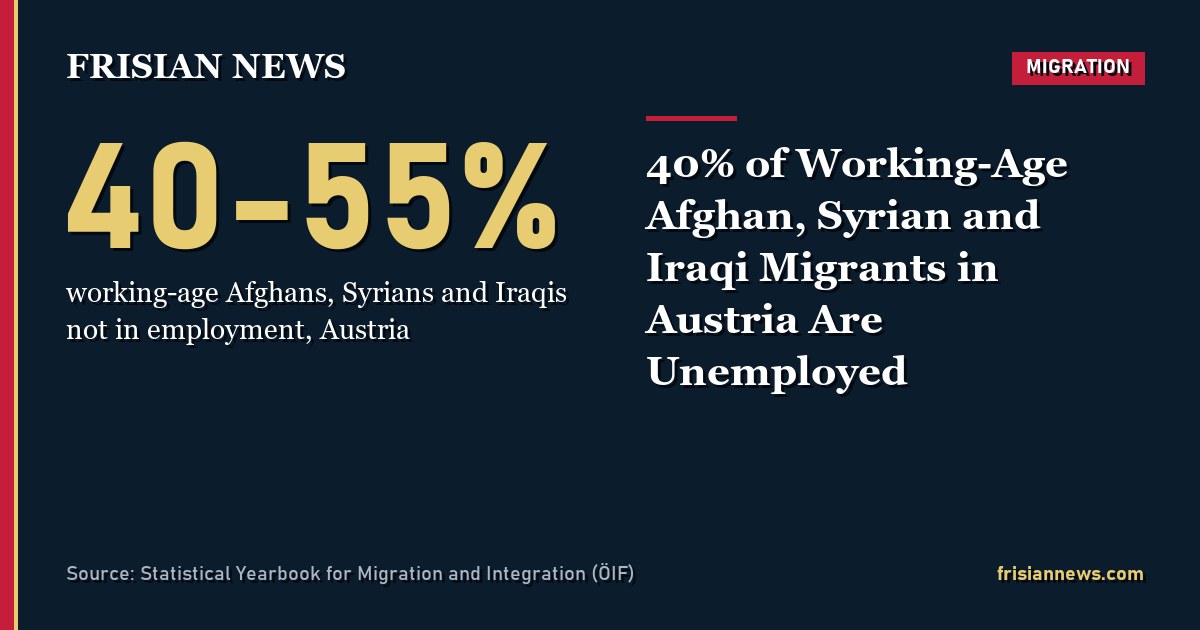
40% of Working-Age Afghan, Syrian and Iraqi Migrants in Austria Are Unemployed
November 12, 2026 · Frisian News
Austria's Statistical Yearbook for Migration and Integration puts the non-employment rate among working-age Afghans, Syrians and Iraqis at 40 to 55 percent. The country's overall registered unemployment rate is 7.4 percent.
Between 40 and 55 percent of working-age Afghans, Syrians, and Iraqis in Austria are not in employment, according to the Statistical Yearbook for Migration and Integration published by the Austrian Integration Fund (ÖIF). Austria's overall registered unemployment rate is 7.4 percent, ÖIF data show.
Those headline unemployment figures do not capture the full picture. Austria counts as unemployed only people who are actively seeking work. By that measure, 33 percent of Syrians and 23 percent of Afghans are registered as unemployed, ÖIF data show. The broader non-employment rate, which includes working-age people who have stopped looking for work entirely, pushes the share to between 40 and 55 percent for these three nationalities, the Statistical Yearbook shows.
Women account for much of that gap. Only 24 percent of working-age women from Afghanistan, Syria, and Iraq are in employment, the Statistical Yearbook reports. Austria's overall female employment rate is 71 percent, Statistik Austria data cited by the ÖIF show.
The Austrian government has proposed a remedy. Integration Minister Claudia Bauer of the ÖVP is backing an Integration Duties Law, due to take effect in 2027. The legislation requires migrants to learn German, accept Austrian values, and actively seek work. Those who refuse face a cut in welfare payments, from a full rate of around €1,016 per month to a reduced rate of €861. Fines of up to €5,000 attach to violations including exam fraud, integration fraud, and submitting false language certificates.
Chancellor Christian Stocker, also ÖVP, was clear about the intent. "Whoever wants to live in Austria must learn German, accept our values, and be ready to build an independent future through work," he said. The rival Freedom Party of Austria (FPÖ) has labelled Stocker weak on immigration.
The employment trajectory among earlier arrivals offers some context, but no comfort. ÖIF research tracking Syrian and Afghan refugees who arrived in 2015 and 2016 found that, among men who stayed, 76 percent were working at least 90 days a year after seven years. Among women the trajectory was far slower: 18 percent were employed after five years, rising to around 40 percent after eight or nine years.
Austria's public employment service, the AMS, counted 35,146 refugees and subsidiary protection holders registered as unemployed or in training in October 2026, AMS data cited by the ÖIF show. Syrians made up the largest share at 17,271 people, followed by Afghans at 7,614 and Iraqis at 1,306.

Published November 12, 2026 · Frisian News