£30,000 Per Property: Labour's Fine for Landlords Who Miss the 2030 EPC-C Deadline
November 10, 2026 · Frisian News
Labour's Energy Independence Bill sets civil penalties of up to £30,000 per property on landlords who miss the EPC rating C minimum by 1 October 2030. With roughly 10.1 million homes in England and Wales currently below band C, the government has not matched the fine against either the scale of non-compliance or the rent increases tenants could absorb.
Up to £30,000. That is the civil penalty each landlord in England and Wales will face per property if they fail to bring their rental home to EPC rating C by 1 October 2030, under the Energy Independence Bill introduced to Parliament on 4 November 2026.
The fine is not a single charge. EPCDeadline.co.uk explains that it breaks into two parts: up to £10,000 for letting a non-compliant property, and up to £20,000 for ignoring the compliance notice that follows. A landlord who responds promptly to a compliance notice faces a £10,000 ceiling. One who ignores it faces the full £30,000. The penalty applies per property, per breach, so a landlord with ten non-compliant homes could face up to £300,000.
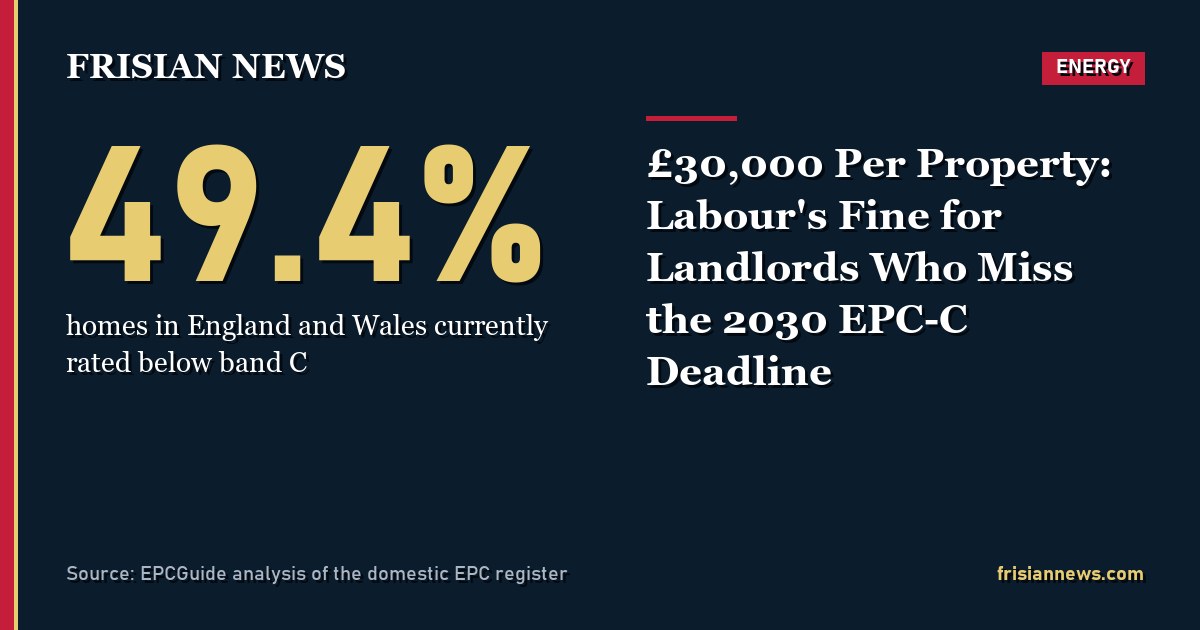
EPCGuide's analysis of the domestic EPC register puts 49.4% of all homes in England and Wales below that threshold. That is roughly 10.1 million homes. EPCGuide notes that the private rented sector historically carries a higher proportion of poorly rated properties than owner-occupied housing.
EPC Advisor estimates between 2.5 million and 2.9 million rental properties need upgrading to reach the new minimum. The government set a £10,000 cost cap per property, or 10% of the property's value for homes worth under £100,000. A Barclays survey of real estate customers, cited by Residential Landlord, put typical EPC compliance costs at £9,000, leaving very little headroom before landlords hit the cap without reaching band C.
Ministers say upgraded homes will save tenants around £210 a year on energy bills by 2030. The Renters Rights Act 2025 rule preventing landlords from raising rent more than once a year continues to apply alongside the efficiency timetable.
The new penalty is a sixfold increase on the current maximum. Under the Minimum Energy Efficiency Standards introduced in 2018, the ceiling was £5,000 per property. EPCDeadline.co.uk reports that Wandsworth Council issued five separate £5,000 penalties totalling £25,000 under the existing, lower regime, all for properties failing to meet band E, the current minimum, not the new one. Councils keep the fine revenue. Local authorities gain better access to compliance data under the new Bill, sharpening that financial incentive.
The National Residential Landlords Association warned, as reported by Residential Landlord, that a late retrofit rush will push up costs as 2030 approaches. The NRLA called for a clear delivery plan covering installer capacity, finance, advice and enforcement. The government plans a Warm Homes Agency, to be created under the Bill, to simplify guidance and support through the Warm Homes Plan. That body does not yet exist in law.
An almost identical policy package was announced and then scrapped in September 2023, EPCGuide notes. The Energy Independence Bill changes that. The fine is now tied to primary legislation, and 1 October 2030 is fixed in policy even before the Bill clears Parliament.

Published November 10, 2026 · Frisian News